TB is curable, when every dose is taken for the full course.
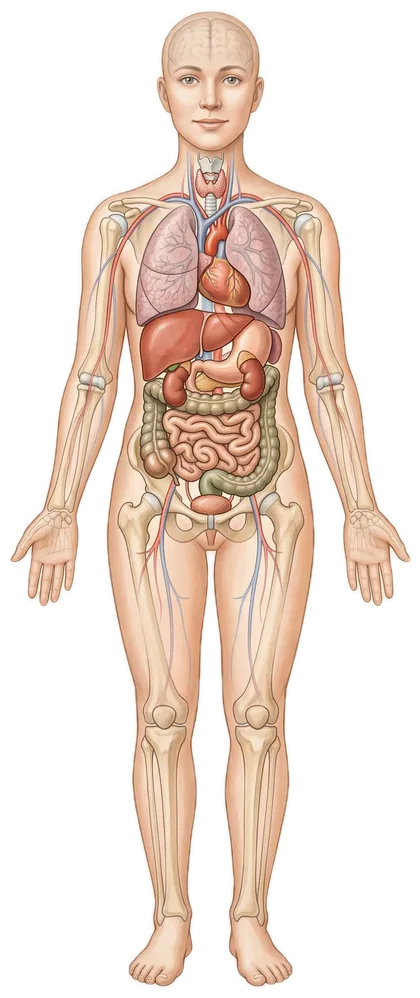
Tuberculosis (TB) is caused by a slow-growing germ, Mycobacterium tuberculosis. It spreads through the air when a person with TB of the lungs coughs, sneezes or talks. It most often settles in the lungs, but it can affect almost any part of the body. With the right medicines, taken every day for at least six months, most people are fully cured.
Reviewed by Dr. Prabhat Arya, MBBS, MD (Internal Medicine)
Reviewed · Next review · Sources: WHO, NHS, Central TB Division, Government of India
In plain words.
TB of the lungs usually brings a cough lasting more than two weeks, often with fever in the evening, sweating at night, weight loss and loss of appetite. Some people cough up blood. Only TB of the lungs or throat spreads to others; TB elsewhere in the body usually does not.
TB outside the lungs can come without any cough at all: a painless lump in the neck that slowly grows, back pain that will not settle, a swollen or aching tummy, fluid around a lung, or fever with headache. Often the only clues are a fever that keeps coming back and weight that keeps falling.
Many people carry the germ asleep in the body without being ill or able to spread it. It wakes when the body’s defences drop. That is why diabetes, HIV, poor nutrition, smoking, heavy drinking, kidney failure and medicines that weaken immunity, such as steroids, raise the risk, as does living with someone who has TB of the lungs.
Tests and medicines are free across India under the National TB Elimination Programme (NTEP), whether you are treated at a government centre or by a private doctor who registers you on Nikshay. Every TB patient registered on Nikshay, the government’s TB record, is also entitled to ₹1,000 a month for food under the Nikshay Poshan Yojana, paid into their bank account for the whole course of treatment.
How TB spreads, and is cured
Spreads by air
A person with TB of the lungs coughs out tiny droplets that hang in the air of a closed room. Someone who breathes them in can catch the germ. A covered cough, a mask and open windows cut the risk, and after about two weeks of the right medicines most people stop spreading it.
Beyond the lungs
The germ can travel in the blood to the glands of the neck, the spine, the tummy, the lining round the lungs or the brain. Here there may be no cough at all, and TB in these places does not usually spread to others.
Six months
The first two months kill most of the germs, and you feel better within weeks. The last four months kill the slow, hidden ones. Stop early and those survivors can return as drug-resistant TB, which is much harder to cure.
Go to hospital now if
- Coughing up more than a few streaks of blood, or clots of blood: go to hospital now.
- Fever with a severe headache, a stiff neck, repeated vomiting, a fit (seizure), confusion or unusual drowsiness: go to hospital now.
- Back pain with new weakness or numbness in the legs, or loss of control of urine or stools: go to hospital now.
- On TB medicines, with yellow eyes or skin, or vomiting that will not stop: stop the TB medicines and see a doctor today.
- On TB medicines, a rash with fever, blisters, peeling skin or mouth sores: stop the TB medicines and go to hospital now.
- On TB medicines, blurred vision or colours looking faded (especially red and green): stop the TB medicines and see a doctor today.
- Severe breathlessness, sudden sharp chest pain with breathlessness, or lips turning blue: call 112.
Call 112 or go to the nearest emergency department. Ambulance: 108 (102 in some states).
See a doctor within a few days if
- A cough has lasted more than two weeks
- You have had fever, night sweats or weight loss for more than two weeks, with or without a cough
- A lump in the neck has lasted more than a few weeks, or is growing
- Someone in your home has TB, even if you feel well
- If you have HIV or diabetes: any cough, fever, night sweats or weight loss, however short
- On TB medicines: a new rash without fever, or burning or tingling in the feet
Tests that help.
Not everyone needs every test. He decides which ones are worth doing for you.
| Test | What it tells |
|---|---|
| Phlegm (sputum) test by machine: CBNAAT or TrueNat | The main test for TB of the lungs. It finds the germ’s genes, usually with an answer the same or next day, and shows whether it resists rifampicin, the most important TB medicine. Free at government centres. |
| Phlegm smear under the microscope | An older, quick test. It finds TB only when there are many germs, so a negative smear does not rule TB out. |
| Chest X-ray | Shows patches or hollows in the lungs. It raises the suspicion of TB but cannot prove it on its own; a sample test confirms it. |
| A sample from the part affected | For TB outside the lungs: a needle sample from a neck gland, fluid from around the lung or in the tummy, or a small biopsy, tested by the same machine and under the microscope. |
| Culture and drug-sensitivity tests | Grow the germ over a few weeks to show exactly which medicines will work. Done when resistance is found or suspected. |
| HIV test and blood sugar | Offered to everyone with TB, because both change how TB is treated and followed. |
| Mantoux skin test or IGRA blood test | Show that the body has met the germ at some time, not that TB is active now. Used mainly when deciding on preventive treatment. |
| Blood antibody tests for TB | Banned in India since 2012 because they are wrong too often. Do not rely on them. |
Have it ready.
Tick them off as you gather them. The ticks stay on this phone only.
Online, or in person?
Never stop TB medicines early because you feel better, and never take them on and off. An unfinished course is a major way ordinary TB becomes drug-resistant TB, which needs stronger medicines with more side effects, is harder to cure, and can pass to your family in that resistant form.
A video call can
- Work out whether TB is likely, and which tests are needed
- Go through your phlegm, X-ray and blood reports with you
- Explain the treatment plan and watch for side effects month by month
- Guide you to free medicines, the ₹1,000 a month support, and checks for your family
Needs a visit in person
- Giving phlegm or other samples, at a laboratory or a government TB centre
- A chest X-ray, and needle samples from a lump or from fluid
- Drug-resistant TB, which is treated with a specialist TB centre
- Any sign in the red box: that is an emergency
Hear him explain it.
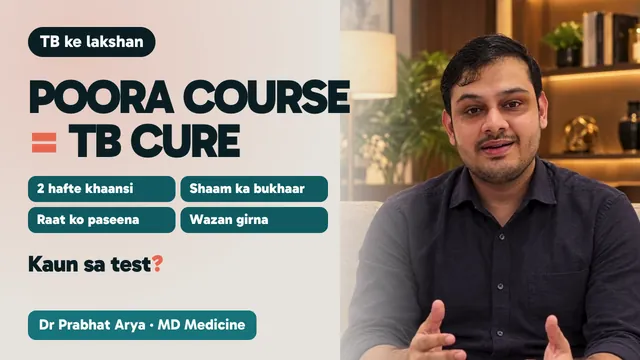
In this Hindi video Dr. Arya explains the signs of TB, such as a cough for more than two weeks, evening fever, night sweats and weight loss, which test to do, why only the full course of medicines (six months for most people) cures it, and why the family should be checked too.
Talk it through with Dr. Arya.
Bring your reports and medicines to a video consultation. He goes through them with you, in plain words, and says clearly if you need to be seen in person.
Book a video consultationDr. Prabhat Arya · MBBS, MD (Internal Medicine)
Reviewed by Dr. Prabhat Arya
Where this advice can be checked
- WHO fact sheet: Tuberculosis
- NHS: Tuberculosis (TB)
- Central TB Division, Government of India: National TB Elimination Programme
These are trusted general sources. The advice on this page is Dr. Arya’s, written for patients in India.