Diabetes means too much sugar stays in the blood.
Sugar from food is the body’s fuel. Insulin, made by the pancreas, lets it into the cells. In diabetes the body makes too little insulin, or stops responding to it well, so sugar builds up in the blood instead.
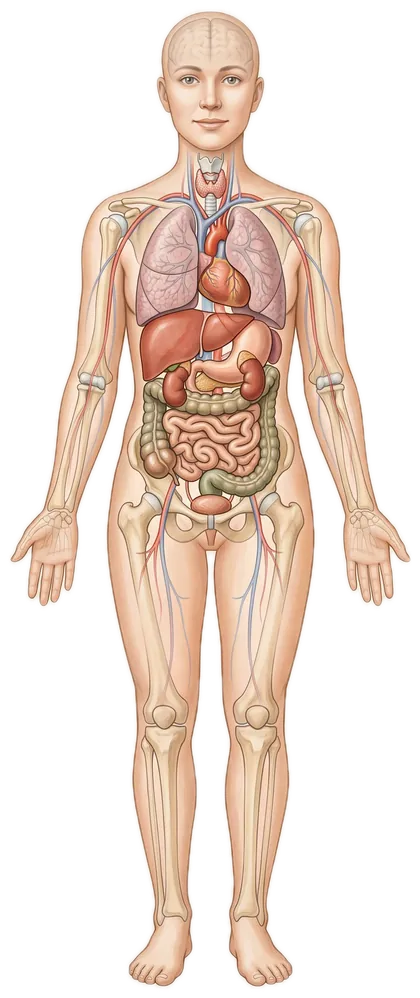
In plain words.
Type 2 diabetes is by far the most common kind in adults. It usually comes on slowly and is linked to weight around the waist, too little activity, family history and age. In India it often starts at a younger age and a lower weight than in many other countries.
Type 1 diabetes is less common and usually starts young. The body makes almost no insulin, so insulin is needed from the start. Diabetes can also appear for the first time in pregnancy.
High sugar rarely hurts at first. Over years it can harm the eyes, kidneys, nerves, heart and feet. That is why it is worth keeping in range even when you feel well.
How insulin lets sugar in
Insulin works like a key. It fits the cell’s lock, a door opens, and sugar moves out of the blood into the cell to be used as fuel.
The lock stops answering the key well. Doors open only a crack, so sugar is left waiting in the blood: that is the high reading on your report.
Go to hospital now if
- Vomiting again and again or cannot keep fluids down, tummy pain, drowsiness or confusion, or fast, deep breathing, even if the sugar is not very high (this can happen on tablets such as dapagliflozin or empagliflozin): call 112. Stop those tablets until a doctor has seen you.
- A low sugar with sweating or shaking does not improve after taking sugar: call 112, and keep taking sugar while you wait if you can swallow safely.
- A low sugar comes with confusion but the person can swallow safely: give sugar and call 112.
- The person is drowsy, having a fit or cannot swallow safely: call 112 and give nothing by mouth.
Call 112 or go to the nearest emergency department. Ambulance: 108 (102 in some states).
See a doctor within a day if
- A foot wound turns red, hot, swollen or smelly, or comes with fever
- Readings stay far above your usual for more than a day or two, or you are unwell and cannot eat
- Low sugars keep happening, or come at night, especially on insulin or tablets such as glimepiride or gliclazide
Tests that help.
Not everyone needs every test. He decides which ones are worth doing for you.
| Test | What it tells |
|---|---|
| Fasting sugar | Sugar after 8 hours without food. 100 to 125 mg/dL is often called prediabetes; 126 mg/dL or more, on two occasions, suggests diabetes. |
| Glucose drink test (OGTT) | Sugar two hours after a 75 g glucose drink, taken after an overnight fast. 140 to 199 mg/dL is often called prediabetes; 200 mg/dL or more suggests diabetes. At home, a reading two hours after a meal helps follow control, but it is a different test and cannot diagnose diabetes. |
| HbA1c | Your average sugar over about three months. 5.7 to 6.4 is often called prediabetes; 6.5 or more suggests diabetes. It is also how control is followed. |
| Creatinine and urine albumin | Whether the kidneys are being affected. Checked at least once a year. |
| Lipid profile | Cholesterol, because diabetes raises the risk to the heart. |
| Eye check (retina) | Done by an eye doctor, usually with drops, once a year, to catch damage early. |
Have it ready.
Tick them off as you gather them. The ticks stay on this phone only.
Online, or in person?
Do not stop or change insulin or tablets on your own, even if the readings look good.
A video call can
- Go through your readings and reports, and explain what they mean
- Look for what is pushing the sugar up: food, routine, sleep, weight, other medicines
- Plan food, activity and medicines with you, and follow up
- Look at a foot wound on camera and say whether it needs to be seen
Needs a visit in person
- A full foot check for feeling and pulses
- The yearly eye check, by an eye doctor
- Blood tests, at a laboratory
- Very high or very low sugar that makes you unwell: that is an emergency

Talk it through with Dr. Arya.
Bring your reports and medicines to a video consultation. He goes through them with you, in plain words, and says clearly if you need to be seen in person.
Book a video consultationDr. Prabhat Arya · MBBS, MD (Internal Medicine) · Delhi Medical Council Reg. No. DMC-83759