The thyroid sets how fast the body runs.
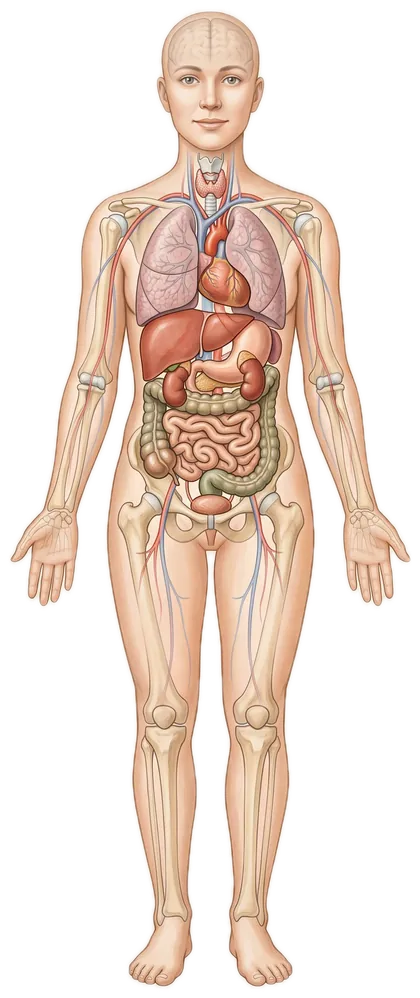
The thyroid is a small butterfly-shaped gland at the front of the neck. Its hormone, T4, sets the body’s speed: heart rate, warmth, energy, digestion. A gland in the brain, the pituitary, watches the level and sends out TSH to ask for more.
In plain words.
An underactive thyroid (hypothyroidism) makes too little hormone and the body slows down. It is common, especially in women, and is usually treated with a daily tablet of thyroid hormone.
An overactive thyroid (hyperthyroidism) makes too much and the body runs too fast. It is less common and needs a different kind of treatment.
The report can look back to front. A high TSH usually means the thyroid is underactive: the brain is asking louder because too little hormone is coming back. A low TSH usually means it is overactive.
Why a high TSH means a slow thyroid
The pituitary sends a little TSH. The thyroid answers with enough T4 to keep the body at its usual speed, and the pituitary eases off.
The thyroid cannot keep up. Too little T4 comes back, so the pituitary asks louder and louder: TSH rises. The body slows down.
The thyroid makes too much T4 on its own. The pituitary goes almost quiet: TSH falls very low. The body runs too fast.
Go to hospital now if
- A very fast or irregular heartbeat comes with chest pain, breathlessness or fainting.
- An overactive thyroid comes with high fever, confusion or agitation.
- Someone with an underactive thyroid becomes very drowsy, confused or unusually cold.
- A swelling in the neck makes breathing or swallowing hard.
Call 112 or go to the nearest emergency department. Ambulance: 108 (102 in some states).
Get an urgent blood count (CBC) the same day if
- You take carbimazole, methimazole or PTU and get a fever, sore throat or mouth ulcers. Stop the tablet until the result is seen. If the fever is high or you feel very unwell, go to hospital now.
Tests that help.
Not everyone needs every test. He decides which ones are worth doing for you.
| Test | What it tells |
|---|---|
| TSH | The first test. High usually means underactive; low usually means overactive. |
| Free T4 | The thyroid hormone itself, to confirm and to see how much. |
| T3 | Sometimes, mainly when the thyroid seems overactive. |
| Thyroid antibodies (anti-TPO) | Whether the body’s own defences are attacking the gland, the common cause of an underactive thyroid. |
| Ultrasound of the neck | When there is a lump or swelling. |
Have it ready.
Tick them off as you gather them. The ticks stay on this phone only.
Online, or in person?
Do not stop or change your thyroid tablet on your own. Tell him if you become pregnant.
A video call can
- Read your TSH and T4 reports with you, including old ones
- Adjust the dose, and plan when to test again
- Look for what else may explain tiredness or weight change
- Follow up a stable thyroid regularly
Needs a visit in person
- Feeling a lump or swelling in the neck
- An ultrasound, or a needle test of a lump
- Care in pregnancy, together with your obstetrician
- A racing heart with chest pain or fainting: that is an emergency

Talk it through with Dr. Arya.
Bring your reports and medicines to a video consultation. He goes through them with you, in plain words, and says clearly if you need to be seen in person.
Book a video consultationDr. Prabhat Arya · MBBS, MD (Internal Medicine) · Delhi Medical Council Reg. No. DMC-83759